
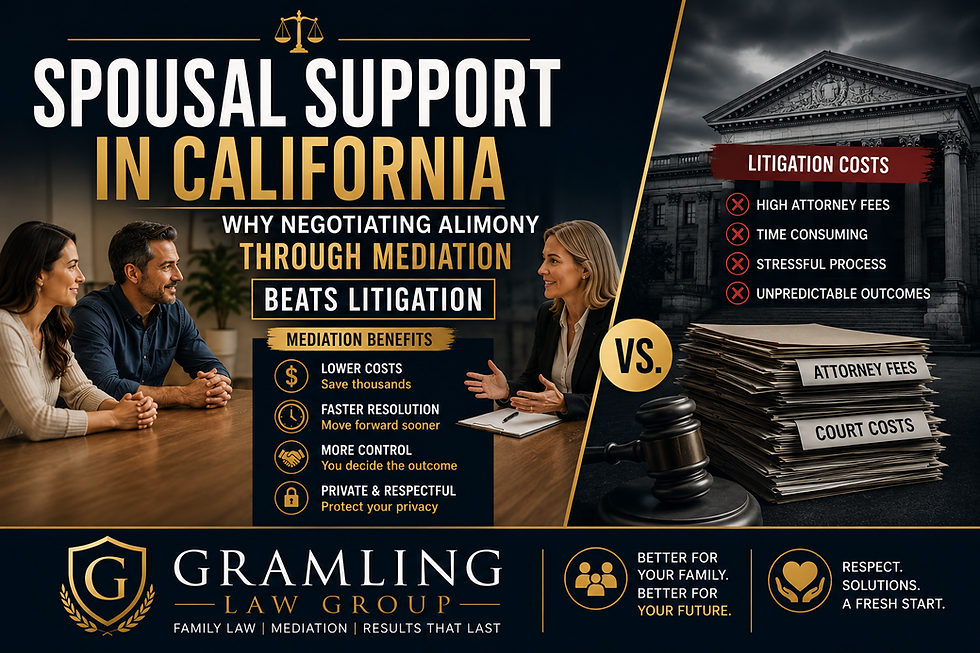
Spousal Support in California: Why Negotiating Alimony Through Mediation Beats Litigation

Updated: Sep 6
Meta Description: Understand California spousal support law. Learn how judges calculate alimony, when you can modify it, and why mediation gives you more control than court.
---
INTRODUCTION
Spousal support. Alimony. The word triggers strong reactions.
If you're paying it, it feels punitive. If you're receiving it, it feels insufficient. Either way, it's confusing. How much is it? For how long? Can you change it if your circumstances change?
Here's the hard truth: California spousal support law is deliberately vague. Unlike child support, which follows a precise formula, spousal support is discretionary. Judges have broad authority to award as much or as little as they think is fair.
This discretion is good and bad. It's good because it allows fairness based on your specific situation. It's bad because it makes predicting what a judge will award difficult—and it makes spousal support a major point of dispute in divorces.
This guide walks you through exactly how California calculates spousal support, what factors judges consider, how long support lasts, and most importantly—why negotiating spousal support through mediation usually beats fighting it in court.
---
WHAT IS SPOUSAL SUPPORT?
Spousal support (also called alimony or maintenance) is income paid by one spouse to the other to help support them during or after divorce.
KEY CONCEPT: Spousal support is different from property division. Property division splits assets and debts. Spousal support is ongoing income payments.
TYPES OF SPOUSAL SUPPORT:
• Temporary support (durational support): Paid during the divorce process (from separation to judgment)
• Permanent support: Continues indefinitely after divorce (though it can be modified or terminated)
The word "permanent" doesn't mean forever. It means the support order doesn't automatically terminate. It continues until modified by court order, until the recipient remarries or cohabits (in most cases), or until the death of either party.
---
FACTORS CALIFORNIA COURTS CONSIDER FOR SPOUSAL SUPPORT
Unlike child support's formula, spousal support depends on numerous factors. California Family Code § 4320 lists 14 factors judges must consider:
1. EACH PARTY'S EARNING CAPACITY
What could they earn based on their skills, education, work history? This is key. Even if you're currently unemployed, a judge might impute income based on your earning potential.
2. THE EXTENT TO WHICH THE SUPPORTED PARTY IS ABLE TO BE SELF-SUPPORTING
Can you realistically become self-sufficient? How long would it take? If you need training or retraining, will the supporting spouse fund it?
3. THE EXTENT TO WHICH THE SUPPORTING PARTY CAN SUPPORT THEMSELVES AND THE OTHER PARTY
Can the supporting spouse afford to pay support while maintaining their own standard of living? What about other support obligations (child support, support from prior relationships)?
4. THE STANDARD OF LIVING ESTABLISHED DURING THE MARRIAGE
This is significant. If you lived a certain lifestyle during marriage, support helps maintain that. A judge might award more support if the marriage was long and the lifestyle was high.
5. THE ABILITY OF THE SUPPORTING SPOUSE TO PAY
Their assets, income, liabilities. Their future earning potential.
6. THE NEEDS OF THE PARTY SEEKING SUPPORT
Housing costs, healthcare needs, childcare costs (if related to earning capacity).
7. THE OBLIGATIONS AND ASSETS OF EACH PARTY
Do you have debts? Do you have assets that generate income? Do you have other support obligations?
8. THE DURATION OF THE MARRIAGE
Short-term marriages (under 10 years): Support often terminates earlier
Medium-term marriages (10-15 years): Moderate support duration
Long-term marriages (20+ years): Judge might award "permanent" support or very long duration
9. THE AGE AND HEALTH OF EACH PARTY
Older parties may have reduced earning capacity. Health issues affect employability.
10. DOCUMENTED EVIDENCE OF CONTRIBUTIONS TO EARNING CAPACITY
Did one spouse work to support the other's career? Did one spouse sacrifice education to support the family?
EXAMPLE: Spouse A worked as a nurse to put Spouse B through medical school. Spouse B became a physician. Spouse A might receive more support because they contributed to Spouse B's earning capacity.
11. THE ABILITY TO WORK WITHOUT DISRUPTING CUSTODY OF MINOR CHILDREN
If you have custody of young children, childcare costs affect your earning capacity. A judge might award support recognizing you can't work full-time while caring for infants.
12. ANY HISTORY OF DOMESTIC VIOLENCE
Domestic violence (either as abuser or victim) is relevant.
13. HARDSHIP TO THE PARTIES
Would support cause undue hardship? Can the supporting spouse afford it?
14. TAX IMPLICATIONS
As of 2019, spousal support is no longer tax-deductible for the paying spouse (and not income for the recipient). This affects the net impact on both parties.
NO SINGLE FACTOR IS DISPOSITIVE. A judge weighs all of them together.
---
HOW JUDGES CALCULATE SPOUSAL SUPPORT (REAL EXAMPLES)
Since there's no formula, here's how judges typically approach it:
EXAMPLE 1: SHORT-TERM MARRIAGE, DISPARATE INCOMES
Jennifer ($35,000/year) and David ($120,000/year) married for 6 years. No children. Jennifer wants spousal support; David argues it's not appropriate.
ANALYSIS:
• Marriage length: 6 years (short-term)
• Standard of living: Jennifer lived comfortably during marriage (David's income supported both)
• Jennifer's earning capacity: She has education and skills; could earn more with effort
• David's ability to pay: His income is substantial; can clearly afford support
• Factors suggesting award: Disparity in earning power, contributed to David's success, needs support transitioning
LIKELY RULING: David pays Jennifer $600-$900/month for 3-4 years (half the marriage length)
EXAMPLE 2: LONG-TERM MARRIAGE, ONE SPOUSE SACRIFICED CAREER
Mary ($40,000/year, part-time) and Robert ($95,000/year) married for 24 years. Mary left her law practice to raise children and support Robert's career. Children are now adults. Mary wants to return to law, but hasn't practiced in 20 years.
ANALYSIS:
• Marriage length: 24 years (long-term)
• Standard of living: High during marriage (combined income $135,000+)
• Mary's earning capacity: Trained as attorney, but 20 years out of practice. Can likely earn $70,000+ if she rehabilitates her practice
• Mary's ability to be self-supporting: Not immediately, but could be within a few years
• Contributions: Mary sacrificed her career to support Robert and children
• Factors suggesting significant award: Long marriage, Mary's sacrifice, need for support while reestablishing career
LIKELY RULING: Robert pays Mary $2,500-$3,500/month for 8-10 years (roughly 1/3 to 1/2 of the marriage length), then support terminates or reduces
EXAMPLE 3: MID-TERM MARRIAGE, EQUAL INCOMES, NEW FAMILY
Lisa ($75,000/year) and Steven ($80,000/year) married for 12 years. They separated; Steven remarried and has a new infant. Lisa is temporarily underemployed but seeking support.
ANALYSIS:
• Marriage length: 12 years (mid-term)
• Income disparity: Minimal (roughly equal)
• Standard of living: Moderate; Lisa can maintain her own
• Steven's obligations: New family, new child support
• Factors suggesting lower or no award: Equal earning capacity, relatively short marriage, Steven has new family obligations reducing capacity to pay
LIKELY RULING: Steven pays Lisa $400-$700/month for 6-8 years, or possibly no support (some judges find equal-income spouses should be self-supporting)
---
HOW LONG DOES SPOUSAL SUPPORT LAST?
There's no set duration formula. Generally:
SHORT-TERM MARRIAGES (under 10 years):
Support typically lasts 1/4 to 1/2 the marriage length
Example: 8-year marriage = 2-4 years of support
MEDIUM-TERM MARRIAGES (10-20 years):
Support typically lasts 50% to 100% of the marriage length
Example: 15-year marriage = 8-15 years of support
LONG-TERM MARRIAGES (20+ years):
Support can last indefinitely ("permanent support")
Or for a very long duration (15-20+ years)
Some judges award permanent support for marriages 20+ years
BUT THESE ARE GUIDELINES, NOT RULES. Every case is unique.
---
WHEN DOES SPOUSAL SUPPORT TERMINATE?
Spousal support terminates when:
• The specified termination date arrives (if it's durational support with an end date)
• The recipient remarries (automatic termination in most cases)
• The recipient cohabits with another person in a romantic relationship (in some counties; courts must evaluate if the recipient's need has reduced)
• Either party dies
• A judge modifies the support based on changed circumstances
NOTE ON REMARRIAGE: If support terminates upon remarriage, that's a strong incentive for the recipient to disclose a new romantic relationship. Hiding it, then claiming you're not in a relationship to keep receiving support, is fraud.
---
MODIFYING SPOUSAL SUPPORT: WHAT CHANGES JUSTIFY MODIFICATION?
Spousal support can be modified if there's a "material change of circumstances."
CHANGES THAT JUSTIFY MODIFICATION DOWNWARD (PAYING SPOUSE):
• Paying spouse's income drops significantly (job loss, demotion)
• Paying spouse becomes disabled and can't work
• Paying spouse retires (though courts scrutinize retirement claims for people under 65)
• Recipient's income increases substantially
• Recipient cohabits with a new partner (reducing need)
CHANGES THAT JUSTIFY MODIFICATION UPWARD (RECEIVING SPOUSE):
• Paying spouse's income increases substantially
• Receiving spouse becomes ill or disabled, increasing need
• Recipient loses a job, reducing self-supporting ability
IMPORTANT: You must file for modification. Simply paying less or receiving less doesn't change the legal obligation. If you stop paying, you accumulate arrears and can face wage garnishment or contempt charges.
---
WHY MEDIATION IS BETTER THAN COURT FOR SPOUSAL SUPPORT
Here's where mediation becomes powerful. Spousal support is discretionary. Judges have enormous latitude. This means:
• UNPREDICTABILITY: You don't know what a judge will award
• DELAY: Court cases take 8-18 months
• COST: Litigation over spousal support is expensive ($8,000-$20,000+ each)
• INFLEXIBILITY: A judge orders specific support; you can't negotiate modifications easily
IN MEDIATION, YOU CAN:
1. NEGOTIATE BASED ON AGREEMENT, NOT JUDGE'S DISCRETION
You and your ex discuss what feels fair given your specific situation. You can agree to less support if it makes sense (you don't want it hanging over you; you'd rather make a clean break financially). You can agree to more support if your ex needs it and you can afford it.
2. BUILD IN FLEXIBILITY
You can agree that support reduces if the recipient remarries. You can agree that support adjusts if the paying spouse's income changes by 10%+. You can agree to termination triggers (e.g., support ends when recipient returns to law practice, or when paying spouse retires).
3. CREATE CREATIVE SOLUTIONS
Instead of monthly support, you could agree to a lump-sum payment. You could agree that support is front-loaded (higher at first, then decreases). You could tie support to specific milestones (support terminates once recipient completes retraining).
4. NEGOTIATE PAYMENT METHODS
Court typically orders wage garnishment. In mediation, you might agree to direct payment, automatic transfers, or even informal arrangement.
REAL EXAMPLE WHERE MEDIATION ADDED VALUE:
Susan and Mark divorced after 22 years. Susan left her accounting career 18 years ago to raise children. She's now employed part-time at $25,000/year. Mark earns $140,000/year.
IN COURT: Judge calculates that Mark should pay Susan approximately $3,200/month permanent support (likely 50%+ of the marriage length given the long marriage and Susan's sacrifice).
IN MEDIATION: They negotiated:
• Mark pays Susan $2,500/month for 5 years (not permanent support, but generous duration)
• After 5 years, support reduces to $1,500/month if Susan hasn't returned to full-time accounting work
• Support terminates completely if Susan returns to full-time work earning $50,000+
• If Mark's income increases 25%+, support increases proportionally
• If Mark becomes disabled or retires before 65, support terminates
WHY THIS IS BETTER:
For Susan: She knows exactly what to expect. She knows she has 5 years to retrain and return to accounting if she wants support to terminate. She has incentive to become self-sufficient, but also security knowing support is there.
For Mark: He's not locked into "permanent" support. He has clear termination triggers. He knows that if he returns to accounting, it creates incentive for support to reduce. He's invested in Susan's success.
Both parties feel the agreement is fair and understand it. There's no resentment about a judge imposing terms.
In court, Mark would resent paying "permanent" support indefinitely. Susan might resent that she has no flexibility or control. The relationship would be adversarial, not collaborative.
---
TEMPORARY SUPPORT DURING DIVORCE
Before final judgment, you can request temporary spousal support to support yourself during the divorce. This is often easier to obtain than permanent support because:
• You need support NOW while the case is pending
• Courts are sympathetic to parties who need to maintain their living standard during litigation
• There's a clear duration (until final judgment)
TEMPORARY SUPPORT IS CALCULATED MORE SIMPLY:
• Disparate incomes? Support might be awarded
• Dependence during marriage? Support likely continues temporarily
• Can you work? Probably, but the court might award support anyway
Many cases settle on permanent support terms that are similar to temporary support that's been in place during litigation. By the time trial arrives, both parties have adjusted to the support level.
---
SPOUSAL SUPPORT LIABILITY: WHAT HAPPENS IF YOU DON'T PAY
If you owe spousal support and don't pay:
• Wage garnishment: Court orders your employer to withhold support from your paycheck
• Asset seizure: Liens on property, seizure of bank accounts, tax refund interception
• Interest accrual: Unpaid support accrues interest (usually 10% per year)
• Contempt charges: Willful non-payment can result in fines and jail time
• Enforcement action: The recipient can hire an attorney to pursue enforcement (and you may be ordered to pay their attorney fees)
This is serious. If you can't afford support, file for modification. Don't just stop paying.
---
HOW GRAMLING LAW GROUP HANDLES SPOUSAL SUPPORT MEDIATION
At Gramling Law Group (https://www.thegramlinglawgroup.com/mediation), our spousal support mediation process includes:
PHASE 1: INCOME VERIFICATION
• We request income documentation from both parties (tax returns, pay stubs, business records)
• We verify earning capacity
• We identify any income claims that seem unrealistic
PHASE 2: ANALYSIS
• We analyze the factors judges consider (marriage length, standard of living, earning capacity, etc.)
• We research what similar judges in your county typically award (to provide context)
• We discuss what a court would likely award vs. what mediation offers
PHASE 3: NEGOTIATION
• We facilitate discussion about what feels fair
• We explore whether durational support is preferable to permanent support
• We discuss modification triggers and flexibility
• We negotiate payment method and amount
PHASE 4: AGREEMENT
• Once agreed, we draft the Spousal Support Agreement
• We file it with the court
• Judge approves it (if both parties consent, no hearing required)
Timeline: 2-4 weeks
Cost: $1,500-$3,000 combined (split between parties)
---
NEXT STEPS: GET SPOUSAL SUPPORT RIGHT
Whether you're facing initial spousal support or modification:
IF YOU'RE NEGOTIATING SPOUSAL SUPPORT:
• Gather income documentation (3 years of tax returns, recent pay stubs)
• Research what similar judges in your county award (ask an attorney)
• Consider your standard of living during marriage and future earning capacity
• Propose mediation to resolve quickly and fairly
IF YOU'RE MODIFYING SPOUSAL SUPPORT:
• Document the changed circumstances (job loss notice, new job offer, income increase documentation)
• Calculate how the modification affects both parties
• Propose mediation before filing a court motion
READY TO NAVIGATE SPOUSAL SUPPORT?
Schedule a free consultation with Gramling Law Group (https://www.thegramlinglawgroup.com/get-a-quote) to discuss spousal support in your situation. We'll explain what judges typically award, help you negotiate fair support, and guide you through mediation if you choose that path.
Or download our Family Law Blueprints™ (https://www.thegramlinglawgroup.com/product-page) for detailed guides to spousal support calculation, modification, and negotiation strategy.
Get spousal support right. Negotiate fairly. Preserve your financial future.
Related Articles
Learn more about our spousal support attorney serving the Inland Empire, Los Angeles County, and Southern California.
Gramling Law Group
3600 Lime St, Bldg 2, Riverside, CA 92501
Phone: (909) 654-4575
Serving the Inland Empire, Los Angeles County, Orange County, and all of Southern California except San Diego in family law and criminal defense.
Follow Daniel Gramling on Instagram: @californiafamilylawyer
Comments